

Raising Firearm-Safe Kids: A Parent's Guide to Living with Guns in the Home
- Christopher Jones
- May 11
- 13 min read
Published by Christopher Jones Lead instructor Valhalla Defense Group | Firearms & Preparedness
Bringing a new baby home or raising young children in a household with firearms doesn't have to be a source of anxiety — it can be an opportunity to build one of the most important safety habits of their lives. For responsible gun owners, the goal isn't to hide firearms and hope kids never find them. It's to build a culture of respect, education, and hands-on understanding from the very beginning. In this guide, we'll walk through how to store your firearms smartly, talk to your kids at every age, introduce them to real handling with training tools, and eventually take them to the range with confidence.

Why "Hiding It and Hoping" Doesn't Work
Many well-meaning parents believe that simply concealing their firearms is enough - but experienced firearms educators and trainers consistently point out that children are resourceful and curious, and a hidden gun is far more dangerous than one a child understands and respects. When a child eventually discovers a hidden firearm without any education or context, they have no frame of reference for what it is, why it's dangerous, or what to do.
The problem with hiding without educating is that it creates a vacuum of information that children will fill with curiosity. A much more effective approach is to demystify the firearm through controlled, age-appropriate exposure and education. When children understand what a gun is - a tool with serious consequences, not a forbidden treasure - they are far less likely to engage in reckless curiosity when unsupervised. This doesn't mean leaving guns out and accessible. It means pairing rigorous safe storage with consistent, ongoing education.[1][2]
Pillar #1: Smart, Secure Storage (Non-Negotiable)
No amount of education replaces secure storage. The two work together — not as substitutes for each other. The foundation of living safely with firearms around children is a layered storage approach that accounts for both security and accessibility.
The Core Rules of Safe Storage
Regardless of your children's age or training level, follow these storage fundamentals every time:[3][4]
Unload before storing. Firearms should always be unloaded when placed in storage.
Lock the firearm. Use a dedicated gun safe, lock box, or at minimum a cable lock or trigger lock.
Store ammunition separately. Keep ammo in a different locked location from the firearm.
Secure keys and codes. Never store combinations or keys with car keys or in obvious places. Children are resourceful.
Don't rely on concealment. A nightstand drawer, a closet shelf, or a shoebox is not secure storage — it is simply a delay.[^4]
Home Defense Accessibility: Balancing Speed and Security
Parents often worry: what if I need quick access in an emergency? Modern quick-access safes solve this problem without compromise. Options include:[5][6]
Biometric safes (fingerprint recognition) - open in under a second and are programmable for one or two authorized adults
Mechanical push-button safes (like the Simplex or Stop Box gun safe) - no batteries required, opens in one practiced motion
Bedside/under-bed quick-access vaults — mount near your bed at eye level for nighttime access while remaining completely inaccessible to children
The goal is a system that an authorized adult can open quickly under stress, but a child — even a clever, curious one - cannot access. Mount your safe at adult eye level rather than floor level for both security and nighttime ease.[^6]
Pillar #2: Talking to Your Kids - An Age-by-Age Guide
Firearm safety education is not a single conversation. It is an ongoing dialogue that evolves as your child grows. Start early, keep it calm and matter-of-fact, and revisit the conversation often - just like teaching them to look both ways before crossing the street. If they initiate the conversation don’t shut them down lead them to the right answers.[^7]
Ages 2-4: Plant the Seeds Early
At this stage, children cannot handle an unattended firearms and should not. But they absolutely can - and should - begin learning the correct response to encountering an unsupervised gun. The NRA's Eddie Eagle GunSafe® Program, created in 1988 in consultation with elementary teachers, law enforcement, and child psychologists, provides the gold-standard four-step response for this age group:[^8]
Stop! Don't Touch. Run Away. Tell a Grown-Up.
Practice this like a fire drill - not just once, but repeatedly, until it becomes a reflex. Make it a game: point to a random object or utilize an inert training firearm, say "pretend that's a gun," and have your child act out all four steps. The Eddie Eagle program has now reached over 31 million children across all 50 states, and a key strength of its approach is that it makes no value judgments about whether guns are good or bad - it simply teaches children a life-saving behavior.[9][10][7][8]
At this age, you can also begin introducing the concept that a gun is a tool - similar to the stove or a power drill - that only responsible adults use. Keep the tone calm. Safety is normal in your home, not a scary subject.[^7]
Ages 4-8: Introduce the Four Rules of Firearm Safety
As your child begins to demonstrate the ability to follow multi-step instructions and understand cause and effect, layer in the Four Universal Rules of Firearm Safety:[11][12]
Treat all guns as if they are loaded - always, without exception.
Never let the muzzle point at anything you are not willing to destroy or buy - control where the barrel is aimed at all times.
Keep your finger off the trigger until your sights are on target - the trigger finger lives along the frame, not inside the trigger guard.
Know your target and what's beyond it - bullets travel through things.
Use a TV remote, a flashlight, or an inert training prop to physically demonstrate these rules. Have your child repeat them back to you. Quiz them casually - at dinner, on car rides - until recitation becomes second nature.[^7]

This is also a great age to involve children in cleaning and disassembly rituals. Let them hold a barrel, an empty magazine, or a slide and explain how each part works. This removes the "black box" mystery of the firearm and gives them supervised contact with real components in a safe context.[^13]
If the parents believe the child is ready hands on learning may be done with a real firearm or with an inert training firearm. If the child shows interest and wants to hold the firearm be open to it just go over the rules prior to placing a firearm in the hands of the child. If the decision is made to allow them to hold the firearms.
Step one is to allow the child to see you visually and physically clear the weapon (builds a good foundation of proper handling procedure).
Have them sit in a specific location and place the firearm in their hands. While they are holding it point out different parts of the firearm (trigger, chamber, muzzle).
Give them the information and describe how the firearms functions on areas of interest.
Remain close and the process of pointing out parts allows the parent to stay close to the firearm while also allowing the child to receive the sense that mom or dad trusts me to handle this potentially dangerous tool (building a foundation of confidence).

Ages 8-12: Hands-On Training Begins
Children who have demonstrated consistent understanding of the Four Rules and show appropriate maturity are ready for structured hands-on training - not necessarily with live ammunition yet, but with training tools designed exactly for this purpose. This is also the time to begin introducing why these rules exist by having age-appropriate conversations about the mechanics of how firearms work and the real-world consequences of a negligent discharge.[^14]
Pillar #3: The Power of Training Guns
One of the best-kept secrets of responsible firearms education is the training gun - an inert or non-firing replica that allows children (and adults) to build muscle memory, learn proper grip and trigger discipline, and practice handling mechanics without any risk of discharge.
Why Training Guns Are So Effective
Training firearms are effective precisely because they look, feel, and weigh close to the real thing - without any of the risk. The principle is the same one used by law enforcement agencies, military units, and NRA instructors: high-volume repetition in a safe environment builds the habits that keep people safe around live firearms.[^15]
When a child has spent hours practicing with a training gun - correctly placing the trigger finger, sweeping the muzzle in a safe direction, keeping it unpointed at people - those behaviors become automatic. When they eventually handle a real firearm, the safe habits are already ingrained.
Types of Training Guns to Consider
Type | Best For | Key Features |
Rubber/polymer dummy guns | Young children ages 4+ | Inert, bright-colored, indestructible; no moving parts; perfect for learning nomenclature and safe handling practices. |
Blue/orange "blue guns" | Ages 7+ | Realistic weight and size; bright safety color; widely used by law enforcement trainers continues learning safe handling practices. |
SIRT Pistol (Shot Indicating Resetting Trigger) | Ages 10+ and adults | Laser feedback system; mimics real trigger pull and reset; immediate visual confirmation of muzzle discipline and trigger control[^16] |
Airsoft/BB training replicas | Ages 12+ with supervision | Allows introduction to sight alignment and trigger press; bridges gap before live fire. |
The SIRT pistol from Next Level Training deserves special mention. It features a laser that fires when the trigger breaks, providing instant feedback on muzzle direction and trigger control. It resets automatically without racking the slide, allowing high-volume repetition. For families with older children ready for more advanced fundamentals work, it is an outstanding investment that law enforcement agencies and professional instructors rely on daily.[17][16][^15]
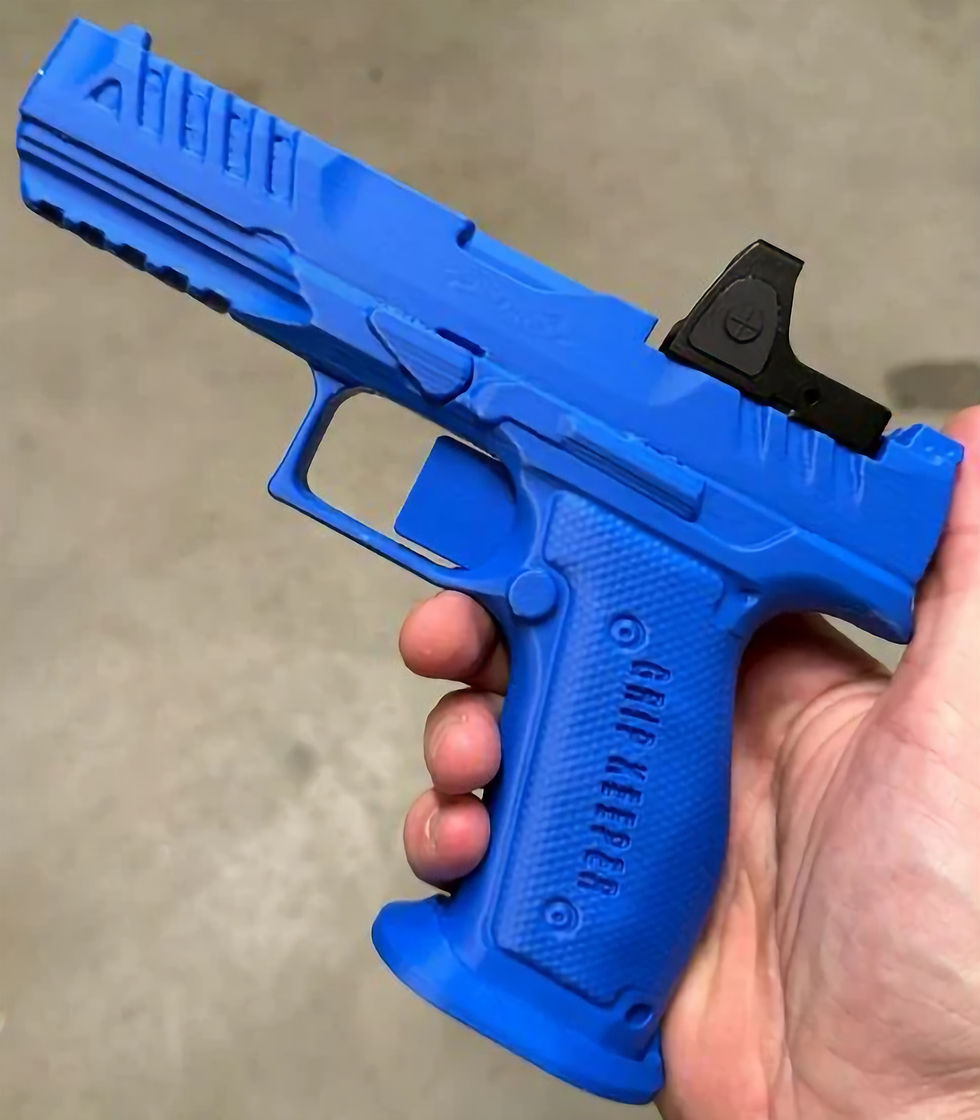
For younger children, bright-colored rubber or plastic 3d printed training guns (often sold in yellow or orange) clearly distinguish themselves from real firearms, making the educational boundary obvious while still allowing proper form instruction. A great option for 3D printed training aid is from Grip Keeper they have options that have no laser or laser.[^18][19]
How to Use Training Guns at Home
Make it a structured, special activity — not casual play. Here's a simple framework for a home training session:
Safety check — Before picking up the training gun, verbally recite the Four Rules together.
Grip and stance — Demonstrate and then have the child mirror a proper two-hand grip. Correct muzzle direction immediately and consistently.
Trigger discipline drill — Practice placing the trigger finger along the frame, then moving it to the trigger only on a verbal cue ("ready to fire"), then back to the frame. Repeat dozens of times.
Dry fire and reset (with SIRT or airsoft) — Practice the trigger press, follow-through, and reset while maintaining sight alignment.
Safe handling scenarios — Practice picking up, handing off (always with barrel in a safe direction), and setting down the firearm safely.
Debrief — Talk about what they did well and what to improve. Keep it positive and encouraging.
Short sessions of 10–15 minutes are better than long ones. Keep the energy fun and the standards firm.[^19]

Pillar #4: The First Trip to the Range
When your child has consistently demonstrated mastery of the Four Rules, proper handling with training guns, and the emotional maturity to follow instructions immediately and consistently, they may be ready for their first live-fire session. This is a milestone — treat it as one.
Are They Ready? Ask These Questions[^19]
Can they recite and explain the Four Rules from memory?
Do they immediately stop and freeze when you say "STOP"?
Will they keep their finger off the trigger without being reminded?
Do they understand and respect the difference between a training gun and a live firearm?
Do they genuinely want to go — or are they being pushed?
There is no universal age for first live fire. Some 7-year-olds are more ready than some 12-year-olds. The maturity of the individual child matters far more than their birthday.[^20]
Setting Them Up for Success
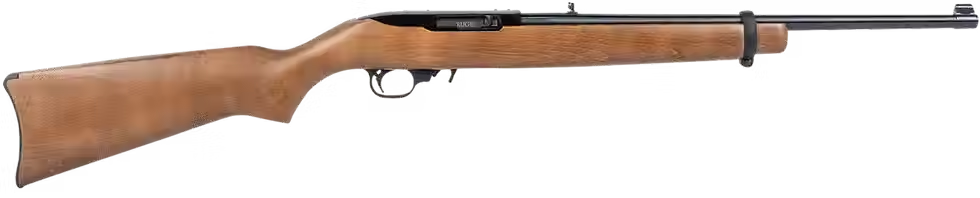
Start small. A .22 LR bolt-action rifle is the gold standard first live-fire firearm - minimal recoil, single-shot operation, and the manual cycling between shots builds patience and deliberate thinking. Avoid starting with handguns; the shorter sight radius and more complex grip mechanics are harder for small hands and new shooters.[21][22]
One on one. For the first range trip, bring only this child. No siblings, no distractions. Your only job is to watch them.[^19]
Visit an outdoor range in advance (without your child) to check age policies and confirm child-friendliness. Outdoor ranges provide a better experience they are typically not a crowded or loud which could produce a bad experience.
Bring proper hearing and eye protection sized for your child. Make wearing it non-negotiable. If possible bring a rest/ bench to shoot off of as holding the rifle can get heavy.
Use large, close targets. Missing frequently is demoralizing. Set them up to succeed with confidence-building target placement.
Keep it short. 30–45 minutes of live fire is plenty for a first session. End while they're still having fun, not after they've gotten tired or frustrated.[^23]
Celebrate afterward. Make it a special family outing — a meal, a treat, a tradition.[^24]
The Power of Seeing Real Consequences
One of the most important educational moments of the first range trip is letting your child see and feel — in a controlled, supervised way — what a firearm actually does. When a child hears the bang, manages the recoil (even from a mild .22), and sees a hole appear in the target, the abstract concept of "this is a serious tool" becomes completely real. This understanding is far more powerful than any lecture and builds a lasting foundation of genuine respect — not fear, not fascination, but respect.[^13]
Building a Culture, Not Just Rules
The most effective firearm safety isn't a single lesson — it's a culture your family builds together. Children who grow up in homes where firearms are treated matter-of-factly, stored responsibly, and discussed openly develop genuine respect for firearms rather than forbidden curiosity. The curiosity that leads to dangerous unsupervised handling comes from mystery and forbidden fruit, not from knowledge.[2][14]
Here are a few habits that build that culture over time:
Regular reviews. Quiz the Four Rules at dinner once a month. Make it conversational, not a test.
Involve them in safe storage. Let older children watch (but not participate in) the locking and unlocking of the safe so they understand and respect the system.
Make shooting a family activity. Range trips with the family reinforce that firearms are a normal, responsible part of your household — not something done in secret.[^24]
Address media portrayal honestly. When firearms appear in movies, games, or TV, use it as a teaching moment: explain what the media gets wrong about how guns behave, sound, and what they do to human bodies.
Open-door policy. Make it clear that your child can always come to you with questions about firearms — including questions about guns they may have seen at a friend's house — without getting in trouble.
A Note on Visiting Other Homes
Just because your home is safely managed doesn't mean every home your child visits is. Make it a habit to ask parents at playdates and sleepovers the same questions you'd ask about food allergies or pet safety: "Do you have firearms in the home? How are they stored?" This isn't judgmental — it's just part of responsible parenting. You can share your own family's practices as a natural way to open the conversation. If the other parent is open too it or unsure about how to teach their child be open to helping and teaching. A key to safety is building a community of like minded and prepared people in your life and family.[^7]
Quick-Reference: Firearm Safety Milestones by Age
Age Range | Key Milestones |
2–4 | Teach and drill Eddie Eagle: Stop, Don't Touch, Run Away, Tell a Grown-Up |
4–8 | Introduce Four Rules; explain guns as tools for adults; involve in disassembly observation |
7–10 | Begin structured training gun sessions; practice grip, trigger discipline, and safe muzzle direction |
10–13 | Advanced training gun work (SIRT, airsoft); introduce sight alignment and dry-fire fundamentals |
When Ready | First live fire on .22 LR bolt-action; range trip as milestone event; gradual progression |
Raising safe, confident, and responsible children in a home with firearms is absolutely achievable - and the path forward is education, not avoidance. When you take ownership of this process, you're not just teaching your kids about guns. You're teaching them discipline, respect, responsibility, and how to be safe in a world that contains real dangers. That's the foundation of true preparedness.
Have questions about training tools, storage solutions, or age-appropriate resources for your family? Reach out to our team — we're here to help.
Recommendation
Training pistols
SIRT training pistol -
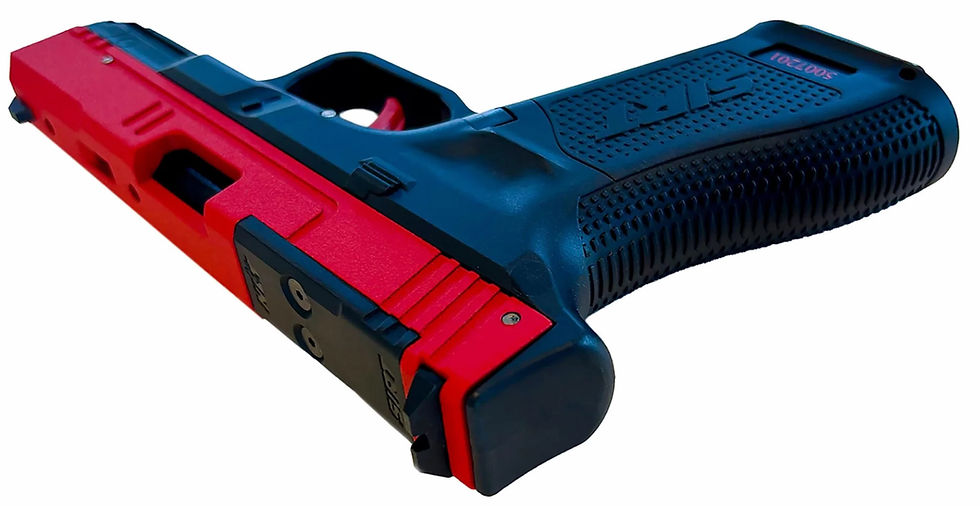
2. Grip keeper 3D printed training pistol
Firearms
Springfield Armory model2020 22LR bolt action rifle

Ruger 1022 semi auto rifle
Henry H1 Classic 22 LR

References
Gun Safety for Kids - Zoom Defense - Our courses are structured to demystify firearms for children in a safe and controlled environment, ...
Gun Safety Programs Do Not Prevent Children from Handling ... - Findings suggest that children do not retain safety skills when encountering a firearm in a real-world.
Safe Firearm Storage | How to Use a Trigger Lock - Strong4Life - Our experts share ways to practice safe firearm storage. Learn how trigger locks, cable locks and safes.
Sports Afield Quick Access Gun Safes - SA Consumer Products - Secure, dependable and always at the ready—the Home Defense Quick Access Safe Series allows you to q...
The Best Quick Access Safes for Home Defense - YouTube - In this episode of The Safe Space, we break down the best quick-access pistol (and compact rifle).
Teaching Kids About Firearms at Home: A 4-Step Parent Script
NRA’s Eddie Eagle GunSafe® Program Reaches 31 Million Children - NRABlog is your connection to the firearm education, safety and marksmanship training programs of th...
Talking to Kids About Guns: A Parent's Guide to Real Safety - How to talk to kids about guns with confidence. Eddie Eagle’s STOP–DON’T TOUCH–RUN AWAY–TELL AN ADUL...
The Eddie Eagle GunSafe® Program - We The Kids, Inc - We the Kids believes it is important to protect our children. One of the best ways to do this is to ...
The Four Golden Rules of Gun Safety (and a Few More You Should ... - What Are the 4 Rules of Gun Safety? · All guns are always loaded. · Never let the muzzle cover anyth...
4 Primary Rules of Firearm Safety - NSSF - 4 Primary Rules of Firearm Safety · Always Keep Firearm Pointed in a Safe direction. Never point you...
3 Ways To Introduce Your Kids to Guns SAFELY - YouTube - ... firearm safety, and understand the difference between toy guns and real guns. So what should you...
Bulletproof Parenting: An Essential Guide to Instilling Gun Safety in Children - The Range of Richfield - Introduction: Passing Down the Love for Firearms Responsibly Hey there, fellow gun enthusiasts! This...
Shot Indicating Resetting Trigger (SIRT) Training Pistols: Dry Fire Done Right - The Loadout Room - There is a ton of training for firearms that can be done without a single round fired. Dry fire trai...
Is The SIRT Pistol Worth It? | Strikeman Dry-Fire Training - Discover why the SIRT pistol is worth it for dry-fire training, trigger control, drawing from conceal...
Replica Rubber Gun Yellow | Gracie Lifestyle - Made from high-quality, durable rubber, this training gun replicates the weight and feel of a real f…
Introducing Kids to Firearms - Of course, the child needs to be closely monitored to make sure they strictly observe these rules of...
7 tips for introducing your kids to shooting sports - WVDNR - So, the best time to introduce your kids to shooting is when he or she has expressed interest in lea...nin
4 Safety Tips for Kids at the Shooting Range - MGS Trade School - On the Big Day. If it's a child's first time, consider having one-on-one time before adding any sibl...
6 Tips For Taking Kids Shooting For The First Time - 1. Make Sure They're Ready and Willing. Each family has its own traditions and standards for determination.
The Best Age To Teach Kids About Guns - Concealed Carry - The focal point of traig kids should start with two things. The ability to pay attention, and und...

Comments