

Choosing a Defensive Handgun: How Instructors Really Think About Caliber, Capacity, and Size.
- Christopher Jones
- May 12
- 10 min read
This overview is meant to guide new gun owners as they choose their first firearm for personal protection.
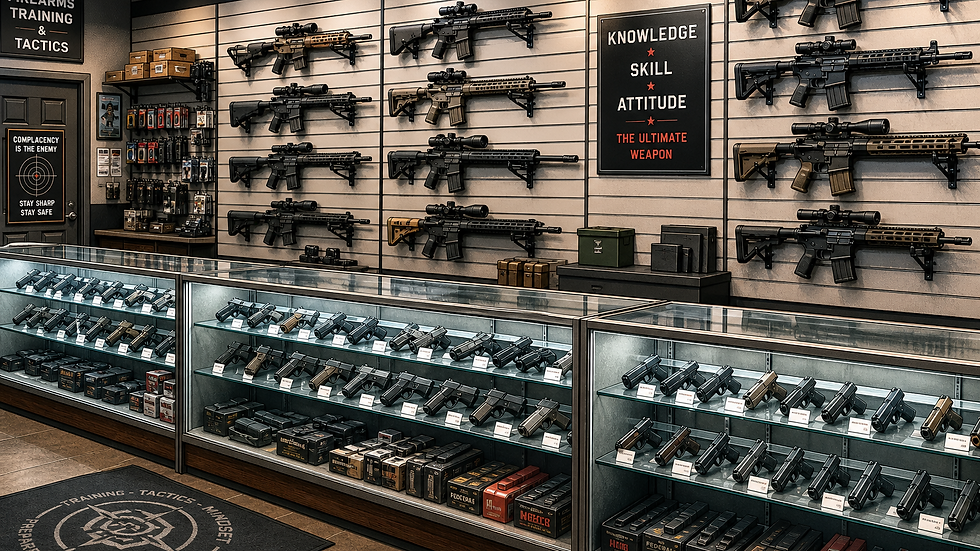
Imagine you make the conscious decision to buy your first firearm for personal protection. You walk up to the gun counter, and there it is: a wall of pistols and a dozen different opinions. Your buddy swears by one brand, the internet says another, and the guy behind the counter has his favorite. Now, you’re more confused than when you started.
As instructors, we look at defensive handguns differently. We’re not chasing the coolest new toy; we’re asking one simple question:
Does this pistol help you protect real people in the real world, or not?
At Valhalla Defense Group, our job is to help you answer that question with clear information and good understanding. We want to ensure you don’t stress when trying to find a semiautomatic handgun that actually fits your life, not someone else’s.
Step 1: Define the Mission Before the Model
Before we talk brands or calibers, you have to answer this:
What is this gun for?
Home defense only
Everyday concealed carry
Duty/open carry
A mix of home defense and carry
Each mission drives different choices.
Home defense: You can lean toward a slightly larger pistol that’s easier to shoot well, with more capacity and a light attached. Comfort to carry all day is less important.
Concealed carry: Size and weight start to matter more. A slim, compact pistol that disappears under a t-shirt is more likely to be carried consistently than a full-size duty gun.
Dual-role gun: You’re looking for the “middle child”—big enough to shoot well at the range, small enough to conceal with a decent holster and belt.
If you don’t define the mission up front, you’ll chase features instead of purpose.
Step 2: Caliber - What Actually Matters
Caliber debates sell a lot of ammo and start a lot of arguments. Here’s the instructor view: for most defensive handgun owners today, 9mm is the standard.
Why?
Manageable recoil for most shooters
Higher capacity in similar-sized guns
Wide ammo availability and modern defensive loads that perform well
The hard truth: a well-placed 9mm from a gun you can control is far more effective than a bigger caliber you flinch with and barely shoot.
Other calibers can have a place:
.380ACP: For shooters with smaller hands, lower strength, or recoil sensitivity who still want a small carry gun.
.45ACP or .40S&W: Potentially useful for specific preferences or duty roles, but they come with more recoil and, often, less capacity in the same size gun.
The question isn’t “What’s the most powerful caliber?” The real question is: “What caliber lets me put accurate rounds on target under stress?”

Step 3: Size, Fit, and How the Gun Actually Shoots
Forget the marketing photos for a moment. Pick up the pistol and ask:
Can I get a full, secure grip?
Can I reach the trigger without stretching or curling my finger awkwardly?
Can I reach the controls (mag release, slide stop) without shifting my grip so much I lose control?
With a full grip, does my grip hold down the slide stop/release?
Is the weapon too heavy?
A defensive handgun should feel like a tool you can drive, not a brick you’re trying to hang onto.
Larger pistols are usually:
Easier to grip
Easier to control under recoil
Easier to shoot accurately at speed
Smaller pistols are:
Easier to conceal
Lighter to carry
Less forgiving of bad grip and trigger control
Most people shoot a compact or mid-size pistol better than a tiny “pocket rocket.” It’s better to have a gun you can conceal and control than a micro pistol that punishes you every time you practice. Like most things in life, if it is uncomfortable to do, you won’t continue to do it. So if a firearm is uncomfortable to train with, odds are you won’t.
If you come train with us at Valhalla Defense Group, we’ll literally put different sizes in your hand, watch your grip, and see what you shoot best. That matters more than the spec sheet.
Step 4: Capacity – Enough Rounds to Solve Real Problems
Capacity is simple:
More rounds are generally better than fewer, as long as you can handle the size of the gun that comes with that capacity.
Reliability and control matter more than squeezing in one or two extra rounds.
For most modern 9mm defensive pistols:
Compact carry guns commonly hold 10–15 rounds.
Mid-size and full-size guns may hold 15–20 rounds or more.
The goal isn’t to carry a bottomless magazine. It’s to carry a reliable pistol that gives you enough rounds to solve realistic problems without sacrificing shootability or concealment.
We also care about quality magazines. A 17-round mag that fails at round 4 is worse than a 10-round mag that runs every time. Until they have been heavily vetted on the range, stick with factory magazines that have also been heavily tested.


Step 5: Features Instructors Actually Care About
There’s plenty of shiny stuff you can bolt onto a pistol. Instructors tend to focus on a few core features:
Sights
High-visibility irons are a must. You should be able to pick them up quickly in daylight and low light.
Night sights or optic-ready slides can be valuable upgrades, especially for defensive use.
Trigger
We’re looking for a consistent, predictable trigger, not necessarily the lightest one.
For most new shooters, a good factory trigger is perfectly fine. You don’t need or want a race-gun trigger on a defensive pistol.
Controls and Safety Systems
Choose a system you can run confidently: striker-fired with internal safeties, or external manual safety if that’s your comfort level.
Whatever you choose, your training must match it. A safety you “sometimes remember” is not acceptable on a defensive gun.
Accessory Rail
Useful for mounting a weapon light on home-defense or duty pistols.
If you plan to run a light, make sure compatible holsters actually exist for your chosen setup.
Everything beyond that—colors, flashy slides, excessive aftermarket parts—usually matters a lot less than people think, especially for a first or primary defensive handgun.
Step 6: Reliability, Support, and the Real World
At Valhalla Defense Group, we care about one thing above all: Does this gun run?
When we talk reliability, we look at:
Track record of the manufacturer
How the gun behaves over hundreds of rounds, not just a single box of ammo
Availability of parts, magazines, and holsters
A great defensive handgun isn’t just a good design—it’s also supported. If it’s hard to find mags, holsters, or spare parts in your area, that gun becomes a harder tool to rely on long-term. We like platforms that students can keep fed, carried, and maintained without jumping through hoops.
Step 7: Budget – Don’t Spend It All on the Gun
This is where a lot of people go wrong. They drop almost everything on the pistol and forget they still need:
A quality belt and holster
At least a few hundred rounds of ammo to break in the gun and train
Possibly a light, extra magazines, and eye/ear protection
Most importantly: training
A simple way to think about it:
Gun: important, but not the whole story
Gear: supports how you actually carry and use the gun
Training: turns that gear into a real capability
We’d rather see you buy a solid, reasonably priced pistol and invest heavily in time on the range than buy a high-dollar gun you’re afraid to shoot because ammo is “too expensive.”
The gun is the hammer. You are the one who has to swing it.
Step 8: Shopping Around – Don’t Marry the First Gun Counter Opinion
Once you have a rough idea of what you want, don’t stop at the first shop you walk into. Different stores have different inventories, different price points, and very different personalities behind the counter.
Some things to watch for when you’re shopping:
Are they asking you questions about your experience level, hand size, and intended use—or just pushing what’s on sale?
Are they willing to say, “I don’t know, let’s look that up,” when you ask something technical?
Do they hand you multiple options to compare, or try to steer you to one “favorite” immediately?
If they give you information and it doesn’t sound correct, question it with another salesman.
Ask technical questions; if the answer is “that’s stupid or that sucks,” be skeptical about the salesman’s real knowledge.
Don’t be afraid to ask the salesman what they carry or use in their day-to-day. If you’re looking for a gun to carry and the salesman doesn’t carry a concealed firearm every day, get a new salesman to assist you.
A good clerk should act more like a guide than a hype man. If you feel rushed, dismissed, or talked down to, that’s a sign to take your money—and your safety—somewhere else.
Step 9: Input From Friends – Filter the Advice
Friends can be a blessing and a curse when it comes to guns. Everybody has “the best gun ever made,” and they’re happy to tell you why.
Here’s how to filter friend advice without starting a war in the group chat:
Ask how they use their gun. Is it carried daily, or does it mostly live in a safe and come out twice a year?
Ask what training they’ve actually done with it. Have they taken classes, shot under time, or just plinked at the range?
Notice whether they talk about comfort, reliability, and performance—or just brand loyalty and looks.
A buddy’s experience is valuable data, but it’s just that: one data point. Your hand size, recoil tolerance, budget, and mission might be different. Use their input as a reference, not a final verdict.
If you bring that friend and their favorite pistol to a class at Valhalla Defense Group, we’ll happily put it to the test side-by-side with other options so you can feel the difference for yourself.

Step 10: Try Before You Buy – Rentals and Test Drives
If at all possible, shoot the gun before you commit to it. You wouldn’t buy a truck without driving it; a defensive handgun that may protect your family deserves at least that much respect.
You’ve got a few ways to do this:
Range rentals: Many ranges offer rental fleets with popular models. This is one of the best ways to compare different calibers and sizes back-to-back.
Friends’ guns: If you have responsible friends with different brands and sizes, ask if you can meet at the range and try a few—with proper safety and etiquette.
Classes that provide guns: Some instructors and ranges have loaner or demo guns that students can run in a course before deciding what to buy.
When you test guns, don’t just fire a magazine and call it good. Pay attention to:
How well you can control the gun in strings of 3–5 shots.
How quickly you can find the sights again.
Whether your hands feel beat up or fatigued after a reasonable number of rounds.
How confidently you can manipulate the controls under a little stress.
At Valhalla Defense Group, we’ve watched plenty of students show up convinced they wanted a tiny micro pistol—until they actually shot it next to a slightly larger compact they could run twice as well. Testing under a watchful instructor’s eye saves you money, time, and frustration.

Step 11: Essential Accessories – Light Before Glass
Once you’ve chosen a defensive handgun that fits your mission, it’s tempting to start bolting on every new gadget you see online. Accessories can absolutely make a defensive gun more capable, but only if they’re chosen with the same seriousness as the gun itself.
For a pistol you might use to defend life, quality matters more than quantity.
Quality White Light: Non-Negotiable
You cannot make good decisions about shooting what you cannot see clearly. In real home-defense scenarios, that usually means low light, awkward angles, and unknown shapes in doorways or hallways.
That’s why, for a defensive handgun, a quality flashlight matters more than an optic.
A good handheld or weapon-mounted light lets you positively identify a target before you press the trigger.
It helps you distinguish a family member from a threat, or a noise from an actual intruder.
It allows you to control what you see and when—short bursts of light, not walking around with a gun and light constantly on.
For defensive use, you’re looking for:
A reputable brand with a track record of hard use in law enforcement or defensive circles
A focused beam with enough output to clearly identify a person across the typical distances inside your home
Simple, intuitive controls you can run under stress with either hand
If you can only afford one serious upgrade on your defensive handgun setup, choose a solid light system and training on how to use it.
Optics: Powerful, but Second in Line
Red-dot optics on pistols have a lot of advantages: faster target focus once you’re trained, better precision at distance, and often better performance in odd shooting positions. They’re fantastic tools—but they don’t replace your need to identify what you’re aiming at.
That’s why, in a defensive context:
An optic is a great force multiplier, but it is secondary to having a reliable light and the skills to use that light correctly.
If you do run an optic, you should still have usable iron sights and a clear backup plan for dot failures (fogging, battery, impact, etc.).
For most new defensive handgun owners, the progression should be:
Solid pistol that fits your mission and hands
Quality belt, holster, and basic support gear
Reliable white light and training on low-light tactics
Only then, consider adding an optic if it supports your needs and budget
Other Basics Worth Doing Right
Beyond lights and optics, there are a few “unsexy” accessories that matter a lot:
Quality holster: Rigid, covers the trigger guard completely, retains the gun securely, and fits your specific model (and light, if mounted).
Sturdy belt: Especially for concealed carry, the belt is what supports the gun, holster, and any accessories.
Spare magazines: Name-brand, reliable mags—not bargain bin specials.
All of this gear should be thought of as part of your defensive system. A cheap light that fails, a flimsy holster that collapses when you try to reholster, or a knockoff optic that loses zero under recoil all undermine the gun you worked so hard to choose.

The Instructor’s Bottom Line
When we help a student choose a defensive handgun, we’re not asking, “What’s the coolest gun in the case?” We’re asking:
Does it fit your mission?
Can you shoot it well under stress?
Will it run when your life depends on it?
Can you afford the training and gear that go with it?
If the answer is yes to those, congratulations—you’re holding a serious defensive tool, whether it’s the internet’s favorite brand or not.
How Valhalla Defense Group Can Help You Choose (and Run) Your Pistol
If you’re staring at options and feeling stuck, you don’t have to figure it out alone. At Valhalla Defense Group, we help students:
Clarify their real mission: home defense, carry, or both before you spend a dollar.
Cut through sales pitches and well-meaning friend advice.
Compare different pistols by how they actually shoot, not how they look.
Set up holsters, lights, and carry methods that match their lifestyle.
Test real pistols on the range, under coaching, so you feel the difference, not just read about it.
Train until that handgun is not just “owned,” but truly forged into their everyday defense.
Bring the gun you already have, or bring a shortlist you’re considering. We’ll give you straight, experience-based feedback and help you build real skill around your choice. Our goal isn’t to crown a “best gun.” Our goal is to help you select a handgun that fits your life, your hands, and your responsibility to protect what matters most.
You’re not just buying a handgun—you’re forging your defense.


Comments